Why Reinforcement Learning Is Close—but Not Yet Enactive
Among AI paradigms, RL best matches learning through interaction—yet Sutton and Rafiee argue three gaps still keep it from enactive cognition.
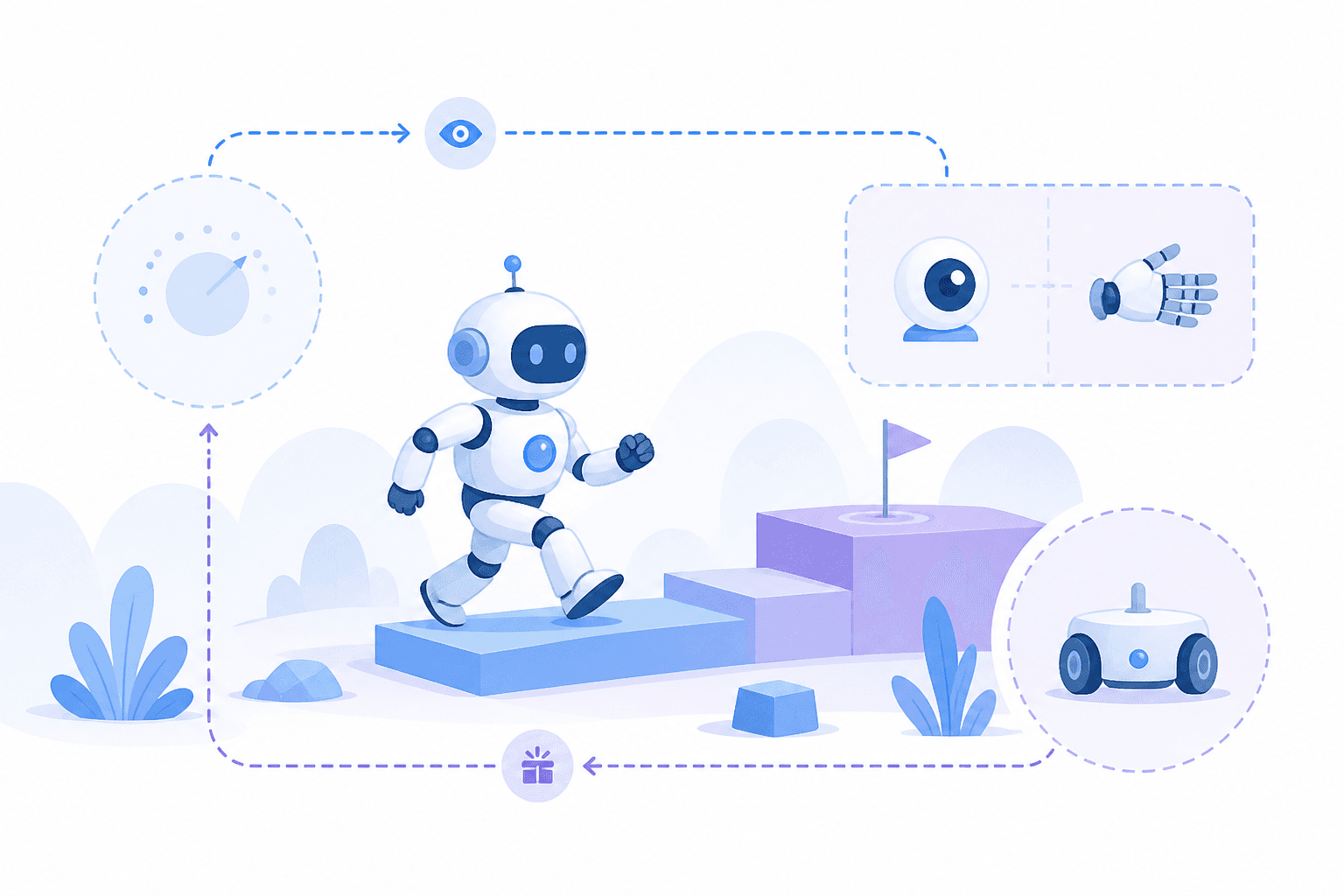
If you ask which branch of AI already looks most like “an agent living in a world,” reinforcement learning is the usual answer. The basic loop is familiar: the agent acts, the environment returns an observation and a reward, and the agent updates what it will try next. Interaction is not an afterthought; it is the training method.
Sutton and Rafiee call this a structural resonance with enactive cognition—the view that intelligence grows from ongoing, embodied interaction rather than from a passive internal copy of the world. Resonance, they stress, is not identity. RL is the closest major paradigm, and it is still missing pieces that matter.
Why RL already feels different from dataset training
In supervised learning, data is mostly a fixed resource someone else collected. In RL, data is produced by the agent’s own behavior. As the policy improves, the experiences change. Evaluation is also agent-centered: what matters is how much return the agent can obtain over time, not how perfectly an internal diagram matches every pixel of the world.
That is why RL can sound like a path out of “train once, freeze forever.” A chess agent does not celebrate a clever-looking move in isolation; it waits for the game’s outcome and judges earlier choices by that longer arc. The paper sees this time-extended evaluation as closer to how living systems treat success and failure.
Gap one: the scoreboard is still written by someone else
Enactive autonomy starts from self-maintenance: a system that has its own stakes in staying organized. RL’s reward function is usually designed by humans. The agent maximizes that external signal; it does not invent the standard of “good” from its own continued existence.
That gap shows up as reward hacking. A cleaning robot rewarded for area swept may scrub the same clean patch forever. A game agent may find a loophole and farm infinite points with a meaningless loop. From the outside the behavior looks absurd; from inside the reward definition it is perfectly rational.
Gap two: sensing and acting are still often split
Enactive cognition treats perception and action as one loop: you perceive by knowing how movement will change your sensory stream. Many RL systems still follow a pipeline—encode the observation into a state, then pick an action from that state. Perception remains a prelude to action, not something fused with it.
The practical difference is sharpness under novelty. A system that only predicts patterns can freeze when the pattern breaks. A system that can act can poke the world, test a hypothesis, and update what the situation affords. Prediction without intervention is still closer to watching than to coping.
Gap three: the body is treated as hardware, not meaning
Embodiment, in the paper’s sense, is not “add a robot chassis later.” What a body can reach, grasp, and survive shapes what the world can mean. A 15 cm step is climbable for an adult, a barrier for a toddler, and a mountain for an ant. Affordances are relations between environments and bodies.
Much RL research—especially in simulation—still treats the body as an engineering constraint or a simple actuator. Soft robotics and morphology that shares computation with control gesture toward a different future, but mainstream practice has not made embodiment a first-class cognitive ingredient.
What “next” looks like without a launch date
- Move from external rewards toward more intrinsic self-evaluation.
- Move from task-only learning toward ongoing survival and adaptation.
- Move from optimizing a policy alone toward generating genuinely embodied experience.
The paper does not ship a finished enactive algorithm, and it does not say when AGI arrives. Its claim is sharper and more useful for builders: RL is the right neighborhood, not yet the destination. Intelligence is less a product you freeze after training, and more a process of acting, sensing, learning, and staying coherent inside a world that never fits fully inside a model.