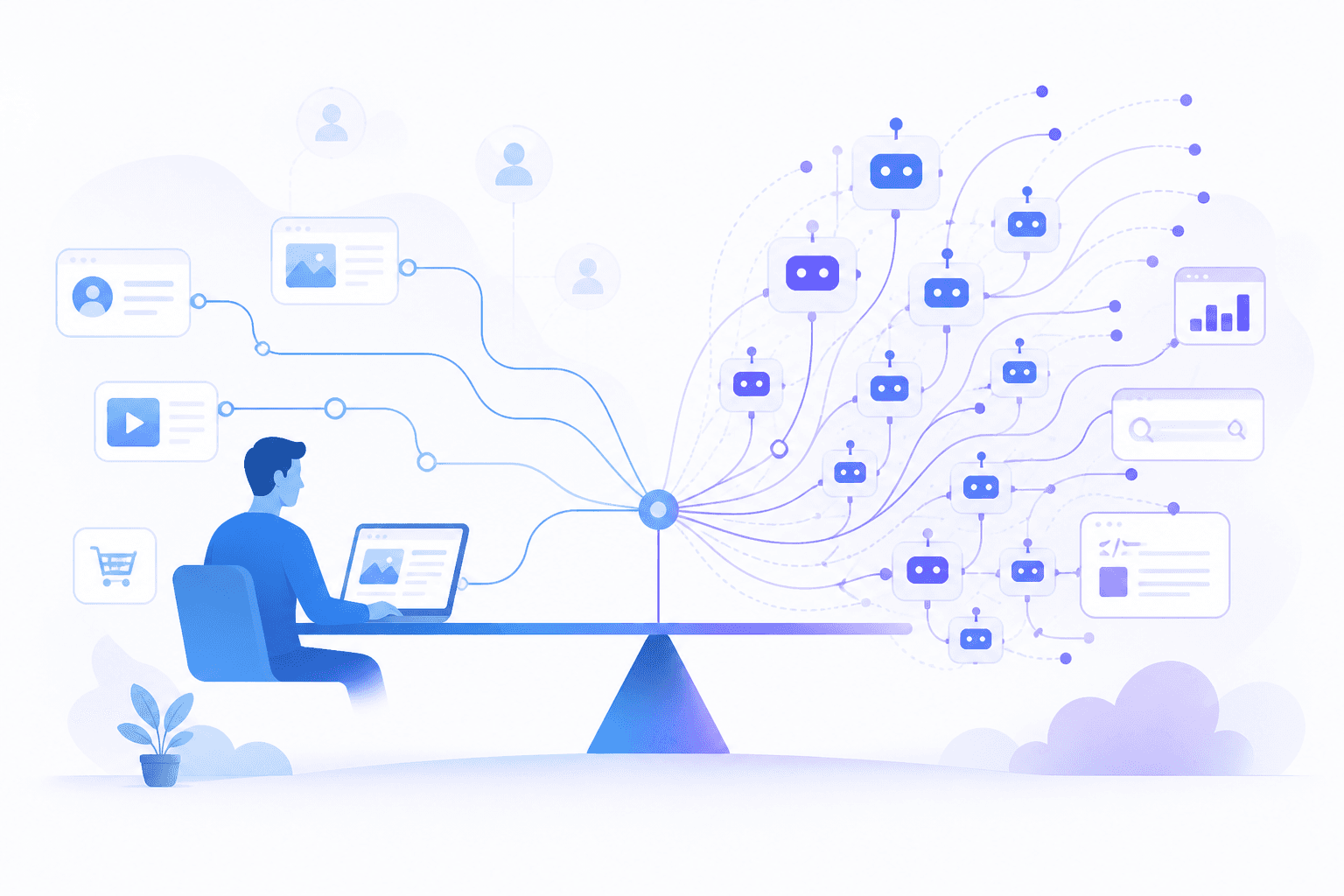
When Bot Traffic Overtakes Human Traffic Online
A plain-language reading of Cloudflare CEO Matthew Prince’s claim that, in the first half of 2026, automated traffic passed human traffic—and why the timeline kept moving forward.
When you open a page or tap a link, it is natural to imagine other people doing the same. Prince’s answer, looking at the traffic that crosses Cloudflare’s network every day, is more unsettling: by the first half of 2026, traffic generated by bots had already passed traffic generated by humans.
That sounds philosophical. From the perspective of a company that handles a huge share of global requests, it is closer to an infrastructure milestone—one Prince said he did not expect to arrive this soon.
Bots were always there—then the curve bent
Prince is careful not to treat bots as a brand-new invention. Search engines have long sent crawlers to fetch pages and build indexes. For much of Cloudflare’s history, he said, bots accounted for roughly twenty percent of internet traffic—so steady that it felt like the normal background of the web.
About two years ago, that calm broke. As large language models and AI agents spread, automated traffic began to rise in a nonlinear way. The interesting part is how quickly the forecast kept moving forward.
- In autumn 2025, Cloudflare’s team, using Radar data, thought the crossover might land around the end of 2027.
- By SXSW in March, newer data pulled the estimate into the first half of 2027.
- Weeks before the interview, the team told Prince that, in the first half of 2026, bots had already overtaken humans.
Prince said he was shocked. If someone sitting at the center of the storm is surprised, the growth rate of AI-driven systems is hard to dismiss as hype.
What counts as a “bot” here?
Cloudflare carries a large enough slice of global traffic that Prince treats the sample as meaningful. Radar, their public platform, tracks human versus bot traffic as a core metric. He also clarified the vocabulary: agent, crawler, and bot are largely the same phenomenon wearing different emotional labels. The substance is automatic access to web resources—not a person staring at a browser and clicking by hand.
Why a thousandfold future would rewrite the web
Prince’s longer extrapolation is starker: within five years, bot traffic could reach a thousand times human traffic. In that world, every page you open sits beside a thousand machine-to-machine visits. The pandemic briefly doubled internet traffic in about two weeks—and felt historic. A thousandfold increase would make that doubling look small.
That is not only a bigger bill for bandwidth and servers. It pressures the commercial logic that funded the open web for nearly thirty years. The crossing of human and bot traffic is the visible tip; the harder question is what kind of internet can still pay for itself when most visitors are machines.