What Are Large AI Models Really Competing On?
A plain-language reading of Moonshot’s GTC talk and the Kimi K2.5 technical report: scaling is no longer just about size.
When people talk about large AI models getting stronger, the usual mental picture is simple: more parameters, more data, more compute. That picture is not wrong — but according to the framework Moonshot presented at GTC, and later documented around Kimi K2.5, it is incomplete.
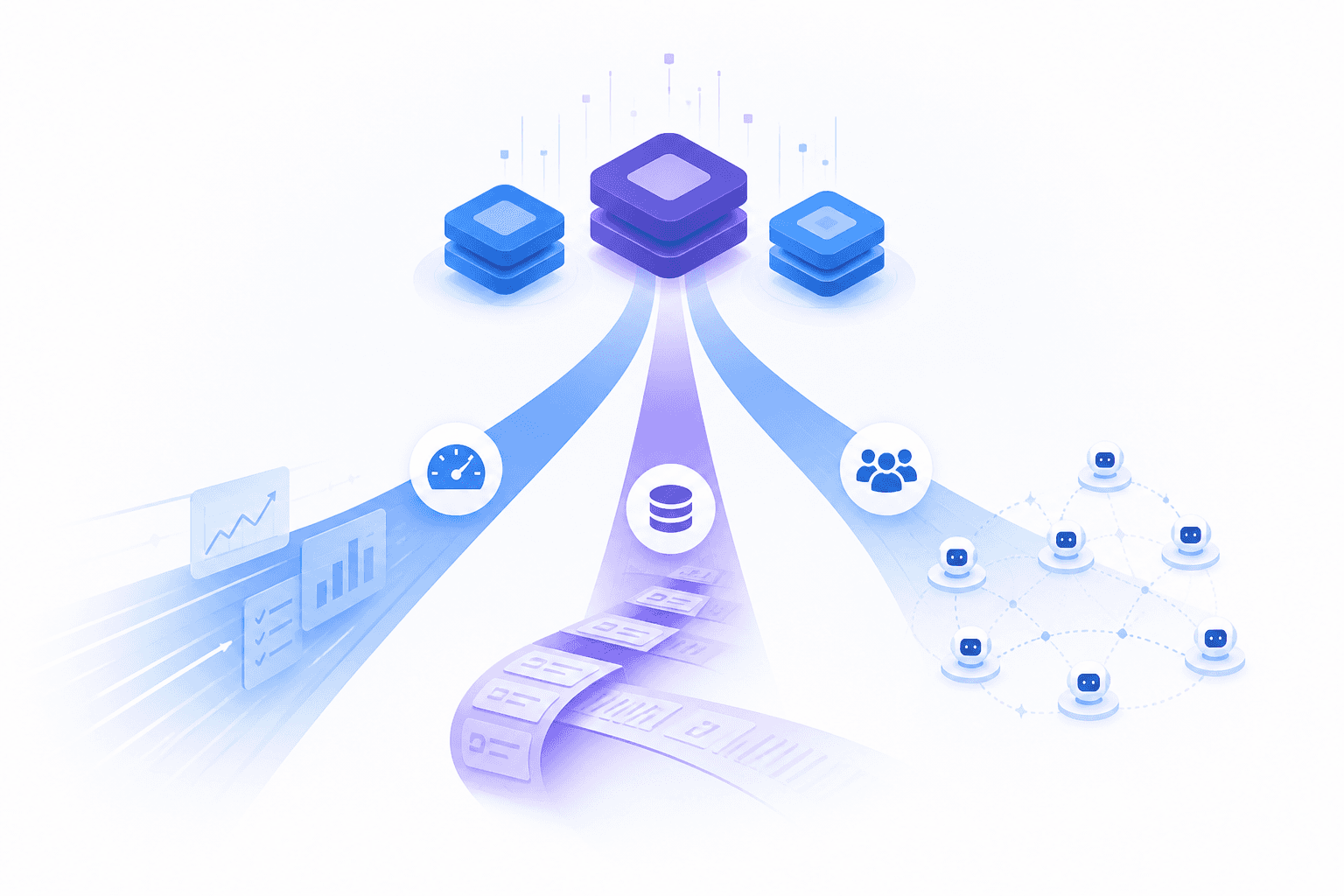
The more useful question is not only “how big,” but “along which dimensions do you get better.” In that talk, the team described scaling along three axes at once.
1. Make every piece of training data count more
High-quality text on the public internet is not infinite. The industry often calls this a “data wall”: you cannot keep digging forever. If the available pool of good data is roughly fixed, then improving how efficiently a model learns from the same material becomes as important as finding more material.
A simple analogy: if two students read the same textbooks, the one who absorbs more from each page still ends up ahead. In the GTC talk, Moonshot framed this as token efficiency — getting more capability out of the same training tokens — and pointed to training-method improvements as one path there. The K2.5 report sits in that same story of careful, large-scale training rather than brute force alone.
2. Remember more of the job at once
Context length is how much information a model can keep in view while working. Short context is fine for a quick chat. Long context matters when the task is closer to real work: reading a whole project, following a long document trail, or staying coherent across many steps.
The GTC framing was practical: longer context supports agents that can run longer and tackle messier problems. You do not need the architecture details to see why that matters. An assistant that only remembers the last few messages behaves differently from one that can hold a large brief.
3. Work as a team, not as a lone genius
The third axis in the talk was the number of agents. Instead of forcing one agent to do everything serially, an orchestrator can split work, assign subtasks, and gather results — closer to how a company operates than how a single employee works overtime.
Why bother? Because wall-clock time matters. A hard task that takes one agent too long may become useful if many agents work in parallel within a time people will actually wait. That is the economic intuition behind “agent swarms” in the K2.5-era narrative: scale collaboration, not only model size.
Put together: smarter, longer-running, collaborative
In agent terms, the three axes map cleanly:
- Better token efficiency → stronger prior knowledge, so search and reasoning waste less effort
- Longer context → agents that can stay on a complex job for longer
- More agents → parallel work on subproblems, then a coherent final answer
None of these ideas sound exotic on their own. The point of the GTC talk — and of reading the K2.5 report beside it — is that competition now looks like engineering progress on several axes at once, not a single leap in size.
In the next article, we look at what this framework means for capabilities people can actually feel — from multimodal work to AI that behaves less like a chatbot and more like a small team.