Why This Generation Cares More About “Twice as Fast” Than Leaderboard Points
From Yann Dubois’s public framing of GPT-era progress: the proudest product wins may be shifting the whole latency–performance curve, not a single flashy skill.
When a new flagship model ships, the loud questions are familiar: What new trick can it do? How many points did it gain on the charts? Dubois’s answer, as a core builder, sounds almost too plain: what he is proudest of is roughly a 2× efficiency lift on everyday work — and a company lined up behind one shared north star.
That framing matters because user experience lives on time and trust, not on a single leaderboard cell. A model that is a bit cleverer but still slow and fidgety loses to one that is good enough, faster, and calm.
Push the whole curve left
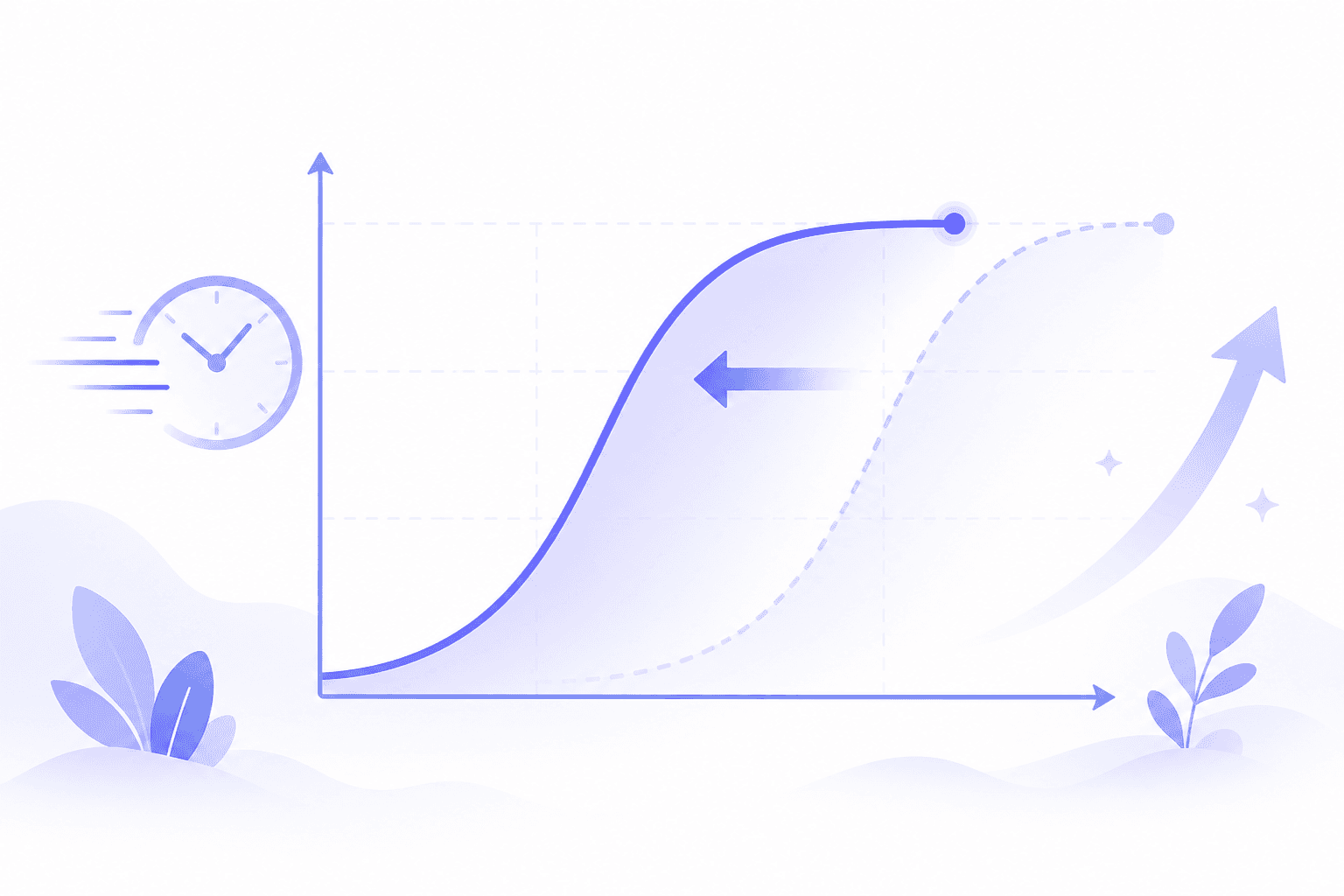
Dubois describes a simple mental chart: latency on the horizontal axis, model performance on the vertical. The research goal is to move that entire curve left — either reach the same accuracy with less thinking (fewer tokens, less wall-clock time), or raise accuracy a lot at the same delay.
Two sides pull together. Inference work turns token counts into real seconds users feel. Model work makes the thinking shorter and better aimed. Only when both move do people experience “faster, sharper, less babysitting” across most daily tasks — not a win in one niche demo.
Pro is not “smarter” — it is allowed to think longer
On the same chart, a Pro-style tier is often just the far end of the curve: more test-time compute, longer reasoning, more resources on hard jobs. Dubois’s blunt line — Pro is not smarter, it is allowed to think longer — is useful for buyers who assume a separate brain lives behind the badge.
Different jobs want different points on the curve. Someone who iterates in chat may rarely need hour-long background runs. Someone grinding a deep math or research problem may happily park a Pro-style job for one or two hours. The product question is whether you can slide along the curve, not only whether you own the top nameplate.
Efficiency looks like expertise, not more thrashing
Dubois’s analogy: an undergraduate may need a day or two to try every plausible path; an expert locks onto the right direction quickly and cuts dead ends early. Reinforcement learning, in this story, trains more of that expert instinct — higher odds of the useful path, earlier stops on bad ones — so reasoning gets cheaper without needing a cartoon jump in “IQ.”
Alignment is part of the product, too
The other “boring” achievement he stresses is company-wide goal alignment: many vertical teams, one shared deadline for a stable, efficient, practical model. In an industry that loves siloed score-chasing, that coordination is rare — and it shows up as whether optimizations actually fuse into one shippable system.
For readers shopping models, the takeaway is practical. Watch the latency–performance trade you feel on your real tasks. Ask whether “Pro” buys you time to think, not a different species of intelligence. And treat leaderboard spikes as clues — not as the whole product story.