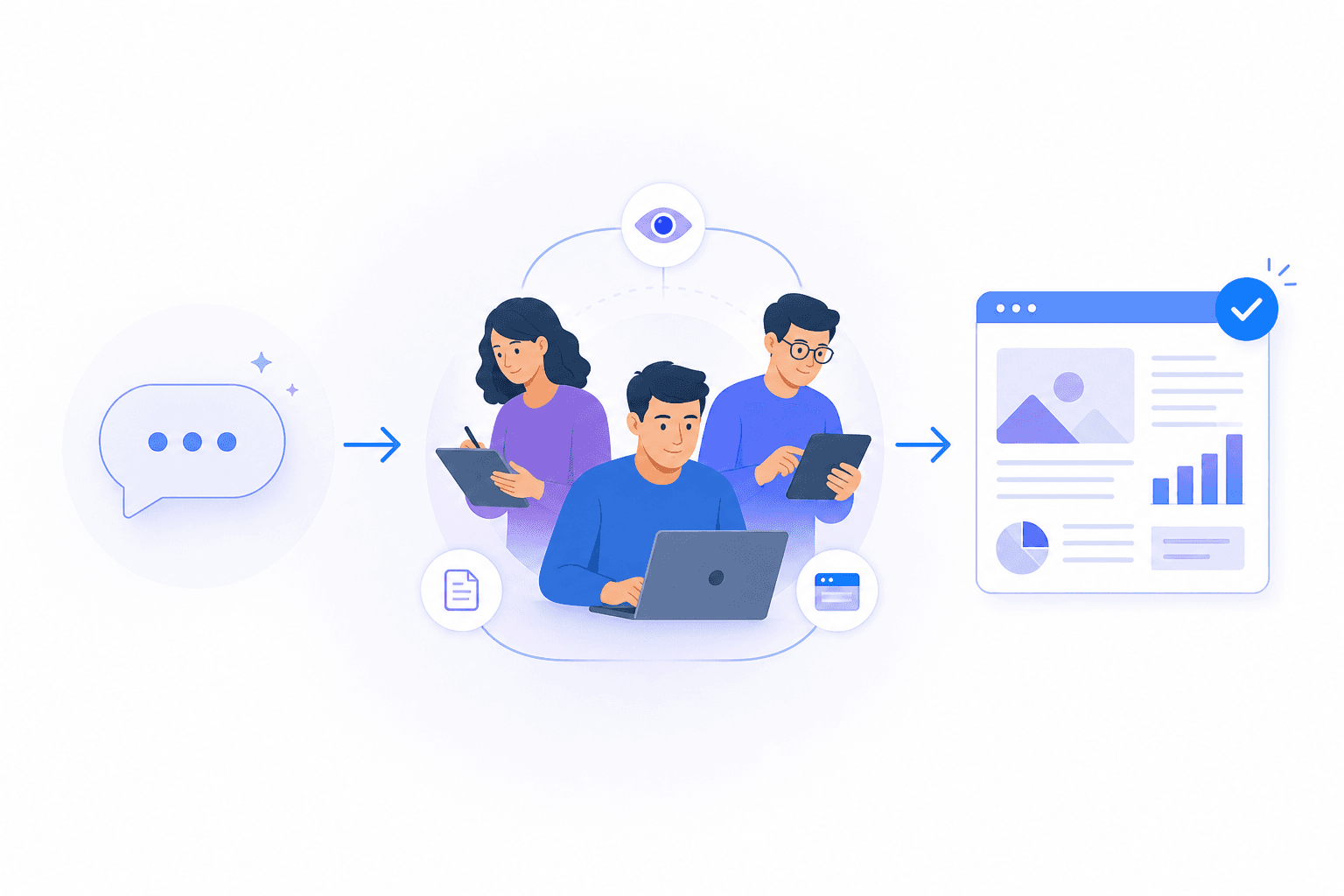
From Chatting Well to Getting Things Done
What the Kimi K2.5 technical report and Moonshot’s GTC talk suggest about multimodal AI and agent teamwork — in everyday language.
If the first article asked what labs are competing on, this one asks a more personal question: what does that competition change for people who just want AI to be useful?
The short answer from the GTC narrative and the K2.5 report is this: progress is not only about sharper answers in a chat box. It is also about models that can see and write in the same workspace, and systems that can divide work the way a small team would.
Learn to see and to write together
Many open models historically learned language first, then added vision later — like finishing a literature degree before taking an art class. The K2.5 materials emphasize a different choice: train vision and text together from early on, sometimes called early fusion.
Why should a non-specialist care? Because some capabilities only show up when seeing and coding share the same “mental workspace.” A demo mentioned in that period — watching a video and generating a webpage that echoes it — is less surprising if vision and language were never trained as strangers.
The report also pushes a counter-intuitive claim: done well, the two modalities can help each other. Vision training is not automatically a tax on text skill; a strong language base can also lift visual performance. For users, the takeaway is simpler than the experiment design: multimodal is not only “add pictures,” it can be “make the whole system sharper.”
A swarm looks like a company, not a chatbot
The GTC talk’s company analogy is easy to picture. A lead agent plays something like a CEO: break the goal down, assign roles, collect drafts, ask for checks, then ship a finished report. One agent researches, another drafts a page, another verifies facts, another fetches files.
That matters because many real tasks fail not from lack of cleverness, but from lack of bandwidth. Parallel reading, parallel writing, and parallel analysis change what can finish within a useful deadline. The talk’s charts about complexity versus time are really about this: collaboration can turn “interesting but too slow” into “worth paying for.”
What ordinary users should watch for next
You do not need to follow optimizer names or attention variants to read the product direction. Watch for systems that:
- Stay useful across long, messy briefs instead of resetting every few turns
- Move between images, video, and code or documents without feeling bolted-together
- Delegate subtasks and return a coherent result, rather than one endless monologue
The closing note in the GTC talk is also the most practical: breakthroughs often look like careful work on the right axes, not a single magical slogan. Public materials around K2.5 are one snapshot of that style — engineering choices that later show up as capabilities people can demo.
For everyday users, the translation is simple. The next generation of useful AI will feel less like a clever conversationalist, and more like a small team that can see the brief, remember the context, and share the load.