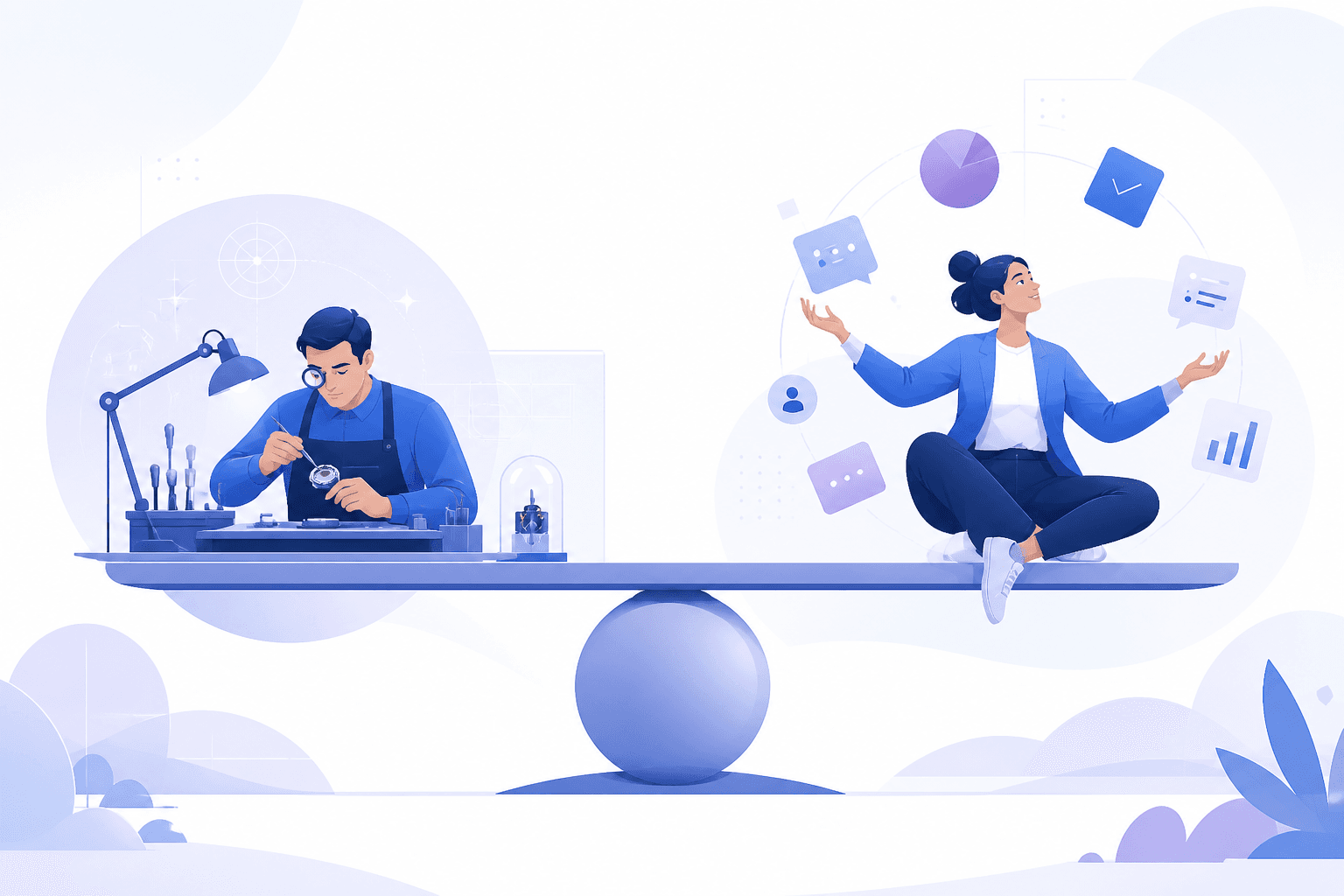
Two Kinds of Workers May Matter Most
From Fei-Fei Li and David Rogier: a “barbell” future of top experts and high-agency generalists—where middling skill is easiest for AI to flatten.
The podcast title teased a sharp claim: in ten years, only two kinds of workers will remain. Rogier floated the frame; Li agreed and pushed it further. The useful version is not doom—it is a barbell: extreme specialists on one end, high-agency generalists on the other.
The middle gets flattened first
School advice used to sound simple: pick a field, go deep, and build a long career. Rogier thinks that path is eroding—unless you are in the top roughly one percent. A merely decent copywriter is now easy to approximate with a large language model. A world-class copywriter is not.
So one end of the barbell is craft taken to an extreme. Across many skill-based fields, the people who are unmistakably excellent become more valuable, not less, when average output gets cheaper.
The other end: high-agency generalists
Opposite the specialists sit people who can do many different things well enough—and who bring strong judgment and initiative. When those generalists partner with top experts, Rogier says, both sides feel something rare: “I truly cannot do what you do.”
Li agrees that whichever side you choose, agency matters. You have to use tools in distinctive, creative, deep ways. She sees designers who already carry human creativity—and then use AI in ways she would not have imagined. That combination is the craft.
Product managers as a live example
For much of the last two decades in Silicon Valley, product manager was a prized role: a connector among users, markets, and engineers—often without writing code. Prototypes meant waiting on designers and engineers; a cycle could take months.
Many PMs now ship simple prototypes themselves with AI—so-called vibe coding—and compress the loop. That does not erase designers or engineers; it frees them for harder work. User research is shifting too, with new ways to simulate behavior and close feedback loops. When Li hires junior PMs, she wants people riding that change—not candidates still describing a five-year-old textbook workflow.
Agency is the shared requirement
Li’s plain answer for how to prepare is agency. AI gives people more leverage; future work will depend heavily on those who know how to use the tools well. Barriers fall; what one person can own expands. Company structures will shift with that—and every student, she says, should try to imagine a role inside that new shape.
She also widens “entrepreneur.” In Silicon Valley the word often means incorporating a Delaware company. For her it is closer to a synonym for initiative—you can be a specialist doctor or a teacher and still work with an entrepreneurial mind: brave enough to stay in charge of the tools, not afraid to learn them.
The takeaway is not that most jobs vanish into two job titles. It is that middling execution gets cheaper fastest—so the durable bets are either unmistakable excellence, or the judgment to stitch many capabilities together and keep moving.