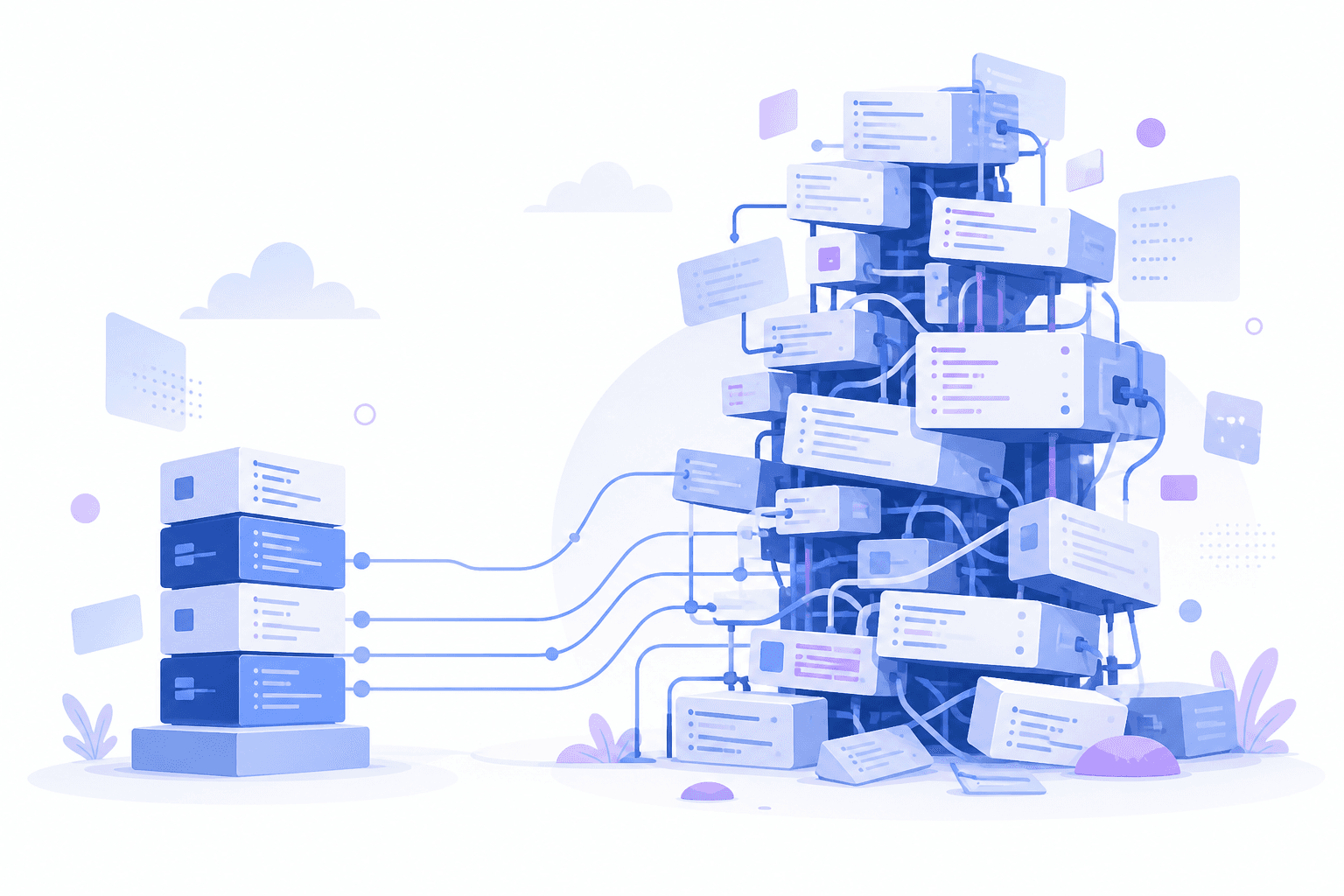
Why AI Technical Debt Compounds
From Anthropic’s Founder’s Playbook: ordinary tech debt accrues gradually; AI-generated debt drifts without a shared design model—and often breaks only after real users arrive.
AI coding agents remove the old bottlenecks that once slowed what reached production. Speed is almost guaranteed. What is not guaranteed is a codebase that still makes sense six weeks later. Anthropic’s Founder’s Playbook names a risk that is easy to miss while every feature still “works”: agentic technical debt. Some shortcuts are fine in an MVP. Ordinary debt builds gradually and can be paid down in a focused sprint. AI technical debt, the playbook argues, compounds.
Every session re-derives the foundations
Think of building with an agent as hiring a very fast contractor who never keeps the same notebook. If architectural principles, forbidden dependencies, and deliberate trade-offs are not written somewhere the model can read, each session re-derives foundational decisions from scratch. Those decisions drift. You get a codebase with no coherent mental model—not because any single piece is bad, but because the pieces were never designed to fit together.
That mess often surfaces late. Early demos look fine. Load grows, features stack, and the shortcuts that bought velocity start charging interest—exactly when you can least afford a rewrite.
Speed without a shared design model
In an AI-native startup, the codebase is something you collaborate on session after session. Legibility is not paperwork; it is what keeps AI a force multiplier instead of a source of entropy. Founders who skip specs, architectural decisions, and context files (such as a CLAUDE.md) hit a predictable wall: every new session needs the product re-explained, and generated changes drift from the original vision.
- Write architecture principles and trade-offs before the first production line
- Keep a scope doc: what the MVP does, what it refuses to do, and what user evidence justifies new work
- End sessions with a five-minute log—cheap insurance against architectural drift
Working code is not the same as safe code
Compounding debt is not only about messy folders. Agentic tools generate code that runs; they do not automatically generate code that is secure. Features fail loudly when they break. Security holes stay quiet until someone exploits them. Shipping a live MVP means real data and real exposure—so a security pass before users touch the product is the minimum responsible bar, not a nice-to-have.
Go fast—with a design you can inherit
The playbook’s point is not to slow founders down for its own sake. It is to protect the judgment that AI cannot supply: what to build, what to leave out, and what constraints every future session must respect. Move quickly, but leave behind a design model the next agent—and the next you—can still follow. Otherwise velocity today becomes chaos that compounds tomorrow.